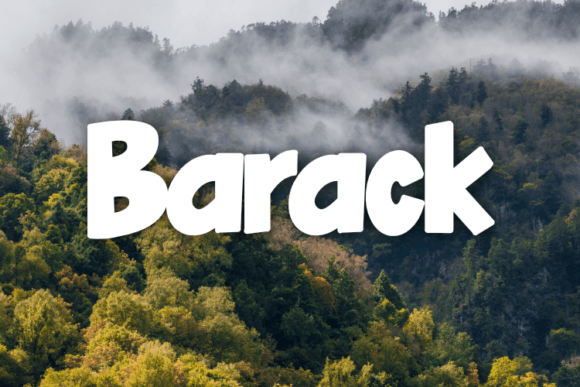
Barack Font: A Display Typeface That Sells Your Handmade Goods
If you’ve ever spent 20 minutes tweaking kerning on a candle label—only to realize the font looks stiff, dated, or just *off*—you’ll understand why Barack instantly feels like a quiet upgrade to your entire design workflow. I’m not talking about another “trendy” font that fades after three seasons. Barack is a display typeface built for makers who need clarity, charm, and commercial flexibility—without sacrificing personality.
Barack has this rare balance: it’s expressive enough to carry emotion in a single word (“Welcome,” “Hand-Poured,” “Est. 2021”), yet structured enough to stay legible at small sizes—say, on a 1.5-inch product tag or a 12pt printable planner header. Its letterforms have gentle contrast and open counters, which means it cuts cleanly on Cricut and Silhouette machines, prints crisply on matte sticker paper, and holds up beautifully when scaled down for digital mockups or Etsy thumbnails.
I use Barack most often for things customers actually *touch*: woven cotton tags for my linen napkin line, foil-stamped wedding welcome boards, and minimalist mug designs sold as printables. It works especially well where warmth matters but clutter doesn’t—like a farmhouse-style sign reading “Gather Here” or a boutique soap label with just the scent name: “Lavender & Rain.” No extra flourishes needed. Just clean presence.
For t-shirt and tote bag designs? Barack shines in short phrases—“Made With Love,” “Slow & Steady,” “Good Things Take Time”—because its rhythm encourages breathing space between letters. It’s not condensed, not overly geometric, and avoids the cold neutrality of many sans serifs. Instead, it carries subtle human texture: slightly tapered stems, soft terminals, and consistent x-height that keeps all caps and mixed-case text feeling unified.
Readability isn’t theoretical here—it’s tested. On ¾-inch round stickers for jam jars? Yes. At 8pt on a folded thank-you card tucked inside a gift box? Still clear. For SVG files used in layered vinyl projects? The outlines are smooth and path-optimized—no jagged edges or unexpected overlaps when converted to cut lines. And because Barack is compatible across software (Illustrator, Canva, Affinity Designer, Cricut Design Space), switching between vector prep and quick social graphics feels seamless—not like wrestling with encoding errors or missing glyphs.
What makes Barack especially useful for commercial crafters is how easily it supports brand consistency. If you sell seasonal collections—think “Pumpkin Spice Collection” in October or “Sunset Citrus” in June—Barack gives each launch visual cohesion without needing custom lettering every time. Its voice stays steady while your colors and layouts shift. Customers begin recognizing that confident, grounded tone—not just your logo, but your *typography*—as part of your shop’s identity.
Pairing Barack thoughtfully expands its range even further. Try it with a relaxed script font (think flowing lowercase “a” and “g”) for invitation suites—Barack handles the names and headings; the script adds intimacy in RSVP lines or poem excerpts. Or combine it with a warm, low-contrast serif for packaging copy: Barack for the product name (“Honey Lavender Balm”), the serif for ingredients and usage notes. It also grounds bolder display fonts—use Barack for subheadings beneath a dramatic vintage-inspired title font, and suddenly your printable wall art feels curated, not chaotic.
Now, about practicalities: Barack is offered in both OTF and TTF formats—so whether you’re prepping files for Printful, uploading SVGs to Etsy, or building Procreate templates, you’re covered. While the listing mentions “available in both o…” (likely referencing OpenType features), I recommend checking the full file package for stylistic alternates or ligatures—these small details matter when designing monogrammed stationery or repeating patterns where “ff” or “tt” connections need to flow naturally. If multilingual support is included (like extended Latin or diacritics), that’s a quiet win for sellers shipping internationally or creating bilingual baby announcements.
Licensing is non-negotiable—and refreshingly straightforward with Barack. The standard commercial license covers physical products (shirts, mugs, tags), digital downloads (PDF planners, Canva templates), SVG-based craft files, client work, and even resale of editable design assets—as long as you’re not redistributing the font file itself. That means you can bundle Barack-powered birthday banner templates or wedding suite kits without second-guessing fine print. No need to purchase separate licenses per product type. Just one thoughtful investment that scales with your shop.
In everyday use, Barack replaces at least three fonts in my toolkit: one for headers, one for labels, and one for “hero text” on product mockups. It’s become my go-to for anything where the words need to feel intentional—not decorative, not distracting, but quietly confident. Whether it’s laser-cut wood signs for local boutiques, heat-transfer vinyl quotes for yoga studios, or printable quote cards for teachers’ lounges, Barack delivers the same thing: professionalism wrapped in approachability.
And let’s be real—crafters don’t have time for fonts that look great on a Behance gallery but fall apart when printed at 300dpi on kraft paper or rendered on a phone screen for an Instagram Story. Barack doesn’t ask you to compromise. It doesn’t require hours of manual adjustment to read well at 14px on a PDF instruction sheet. It just… works. Consistently. Beautifully. Commercially.
If your current display font feels like it’s working against you—too thin for cutting, too busy for small labels, too generic for your brand voice—Barack is worth trying not as a trend, but as a tool. One that helps your handmade goods communicate care, quality, and clarity—before a single word is read.